After an exploration in December of 1852 to Smith Cove and then
to what is now Salmon Bay, David T. Denny placed a claim on 320
acres in what is now lower Queen Anne, generally the area
between today's Denny Way and Mercer St. from Elliott Bay to
Lake Union. Married in January 1853 in his brother Arthur's
cabin, David built his new wife Louisa a one-room log cabin on
the bluff overlooking Elliott Bay, near Denny Way and Western.
Built of nearby trees without a single nail, Louisa planted
Sweetbrier roses outside the front door. The roses were found
still there growing wild in 1931, when they were uprooted for a
new commercial building on the site. Around 1860 the Dennys
cleared an area near 2nd Ave. North and Republican Streets (now
Seattle Center) for a farm, and built a new home, living in it
until 1871.
In the Spring of 1853, Thomas Mercer settled on a land donation
claim just north of David Denny's, an area roughly bounded by
Lake Union on the east, Mercer St. on the south, Queen Anne Ave.
on the west, and Highland Dr. on the north, while Dr. Henry
Smith settled in 1853 in western Queen Anne in the area that
came to be known as Smith's Cove.
The Queen Anne name is derived from the 1880's when Rev. Daniel
Bagley, an early Seattle settler, asked folks jokingly if they
were 'going out to Queen Anne Town?'--for by that time, many
homes in the area were in the Queen Anne style. Several still
exist today, more than 100 years old.
Beginning in 1960 part of lower Queen Anne was reshaped into
what became Century 21, the Seattle World's Fair, where you can
still ride up in the Space Needle, Seattle's most recognized
landmark.
We invite you to visit our site and see a glimpse of Queen Anne
and its history, from our registered landmarks to our
cemetery--the final resting place for many Seattleites.
As published in the Queen Anne News, June 13, 2001
Why Is Our
Community Named Queen Anne?
By John Hennes, QAHS board
member, and a 1951 graduate of Queen Anne High School.
Our Society is frequently asked, “why is our community called
Queen Anne?” It does seem strange for a pioneer western city to
name its most prominent geographical feature after a relatively
obscure 18th century British monarch. The short answer is that
we are not named after the Queen, but are in fact named for the
architectural style of the first houses built up the south slope
of our hill. The longer answer shows how centennials can shape
our view of the world.
In the 1870s, in England, architect Richard Norman Shaw
introduced the Queen Anne or Free Classic residential design. It
was intended to evoke domestic architecture of some 200 years
earlier. The British public loved it, perhaps tiring of the
demands of empire and nostalgic for a simpler past.
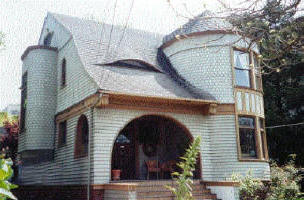
In America, our own first centennial was then approaching and at
the huge Philadelphia Centennial Exhibit in 1876 two model
houses were built in the Queen Anne style. Americans,
experiencing a wave of centennial-induced nostalgia for their
own colonial past, immediately took to the style. Henry Hobson
Richardson, an American architect, began shaping the Queen Anne
to American uses. Half-timbered and tiled exterior features were
replaced by textured and shaped shingles, so abundant in our
west. Building magazines, like American Builder, reproduced
Queen Anne designs and spread them across the country.
In pioneer Seattle the city was moving north. The large area
north of Seattle’s city limits was known as North Seattle. It
stretched from Howell Street, just south of Denny, to Salmon Bay
and included the large, unnamed hill we live on. Thomas Mercer
platted the southeast slopes in the 1870s and called it Eden
Addition. Jacob Gaylor later built on top of the hill and there
were references to “Galer’s Hill”. In 1883 North Seattle, north
to McGraw Street, was annexed into Seattle and the population
surged. The population of 3,533 in 1880 rose to 15,727 in 1889
and to 42,837 in 1890. Yearly counts were made as part of the
push to have Washington made a state in the union, and not just
a territory.
The new middle class citizens who built in North Seattle wanted
to be in the mode and built their homes in the newly arrived
Queen Anne style. Thus, coincidentally, the English Queen Anne
style, caught up in the American centennial fever, arrived in
Seattle just in time to spring up on the slopes of our hill.
Edmund S. Meany, in his 1923 book Origin of Washington
Geographic Names, describes how, “about 1880, such citizens as
Clarence Bagley, F.H. Osgood (and others) built homes in the
then prevailing Queen Anne style of architecture. Rev. Daniel
Bagley jokingly asked folks if they were not ‘going out to Queen
Anne Town’? The name has persisted as to the hill, causing
wonderment to newcomers.”
The name Queen Anne Town appeared around 1885, mainly in real
estate promotions. The first regular school on the hill was
named Queen Anne School in 1890 (today’s West Queen Anne). By
1900 the “town” had been dropped and the area was simply called
Queen Anne Hill.
Most of the houses built in the Queen Anne style have long since
been replaced by larger and more modern houses or by apartment
buildings. There are a handful left, such as 520 W. Kinnear
Place, the Ankeny house on Second Avenue W. and the Riddle house
on Highland Drive. The Queen Anne architectural style lasted
only two or three decades, being replaced by Colonial Revival
and other styles in the 1900s.
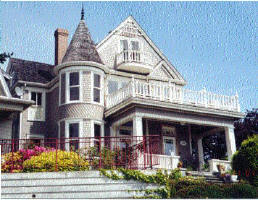 Queen
Anne houses have steeply pitched roofs of irregular shape and
often hipped, usually with a front-facing gable; patterned
shingles and other devices to avoid a smooth-walled appearance;
asymmetrical facades, usually with large partial or full-width
porches; and frequent use of round towers. They can be
half-timbered or partially brick or stone, but in Seattle are
usually all wood. There will be considerable decorative touches
such as porch columns and spindlework borders with textured or
patterned shingles above windows and doors.
Queen
Anne houses have steeply pitched roofs of irregular shape and
often hipped, usually with a front-facing gable; patterned
shingles and other devices to avoid a smooth-walled appearance;
asymmetrical facades, usually with large partial or full-width
porches; and frequent use of round towers. They can be
half-timbered or partially brick or stone, but in Seattle are
usually all wood. There will be considerable decorative touches
such as porch columns and spindlework borders with textured or
patterned shingles above windows and doors.
If the Queen Anne style was devised in the 1870s, what about the
real Queen Anne? Queen Anne reigned from 1702 to 1714. She was
the last of the Stuarts. None of her 17 children survived her
and, upon her death at age 49, Parliament was forced to turn to
the Hannoverian side of the royal family and George I. This is
the ancestor of today’s Queen Elizabeth. To see a true Queen
Anne house you could visit Mompesson House in Salisbury,
England. Built in 1701 and maintained by the National Trust, it
is a true house of Queen Anne’s period. The only common feature
seems to be the hipped roof.
Photos courtesy of the Author
Preserving our
Community Heritage...Now and For The Future
The Denny Real
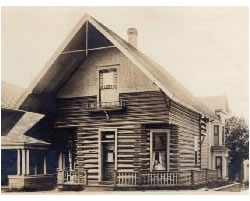
Estate Cabin, built in 1889 by his son-in-law Ed
Lindsley, and grandson Lawrie Lindsley--the
photo was taken in 1901 after the cabin had been
converted to a single family residence--the
small baby in the window is Evangeline Edwards.
(cabin moved to Federal Way in 1966). The cabin
was located on the southwest corner of
Republican and Queen Anne Ave.
|
 |
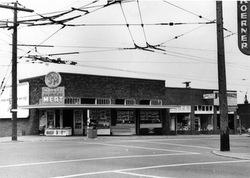
The S&M Market
located at Boston and Queen Anne Ave. was a
mainstay on the corner for many years. It became
Ravenna Gardens, and now is a location for
Peet's Coffee-- a 3rd coffee house at
that particular intersection.
|
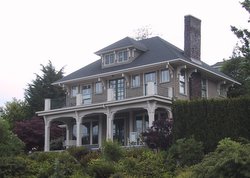
 |
This house at 7th
Ave West and Galer was built to take advantage
of the wonderful westerly views. Today a large
garage has been inserted under the porch in the
foreground.
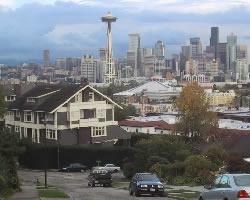
|
 |
One of the
unparalleled views of downtown from Queen
Anne--this one taken from Kinnear Place.
|
 |
A portrait of
Seattle pioneer David Denny, around 1885, taken
from the book by his daughter Emily Denny
entitled "Blazing the Way". David and his wife
Louisa were owners of most of the real estate
now known as Uptown. Most streets in the area
were named for or about the Dennys, including
Republican (David was one), Thomas and John
streets(both sons).
|
 |
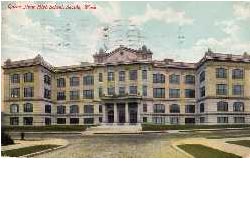
Queen Anne High
School in an early postcard around 1909. Notice
the street in the foreground--now the playground
of John Hay School.
|
 |
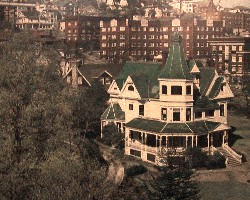
A
later photo of the Kinnear House. The house
immediately to the rear was also built for use
by the Kinnears--George and his wife Angie moved
into it when the front house became too big for
them. His son Charles and his wife lived in the
front house until Charles' death around 1958.
(Destroyed)
|
 |
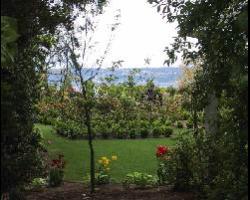
A springtime peek
of the gardens of the Black Residence at 611
West Lee.
|
 |
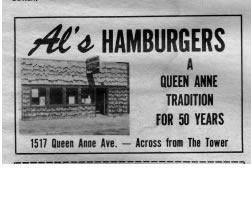
A clip from the
50th anniversary edition of the Queen Anne News,
1971 showing the then location of the popular
Al's Hamburger hangout. It is rumored that the
Queen Anne Alumni Association, during its
outings, still makes hamburgers using the
original Al's grill.
|
 |
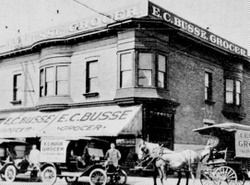
The Ernest C. Busse Grocery is shown proudly
displaying its ability to deliver in this circa
1920 photo. The building originally stood on the
southwest corner of Queen Anne Avenue and Mercer
St. (destroyed)
|
 |
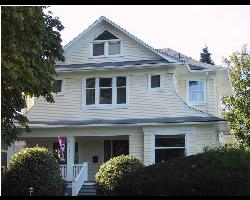
An example of a
restored older home located on top of Queen Anne
Hill, this house is registered as part of our
Historical Marker Program.
|
 |
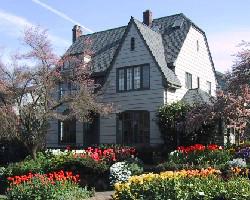
Another example
of a Queen Anne home, located just off Taylor
Ave., this one features beautiful gardens all
spring and summer.
|
 |
To find out more about Queen Anne and to see articles, stories
of historical sites, then and now comparisons, interesting links
and much more, please visit
www.qahistory.org
About the
Queen Anne Historical Society
The Society was formed in 1971 by the History Committee of the
Queen Anne Community Council, and since that time has worked in
many areas to advance its mission of preservation of the
community's historic heritage. An independent non-profit
organization, we maintain a community history archive and hold
bimonthly meetings which feature programs emphasizing community
and Washington history.

Please address inquiries to Queen Anne Historical Society, P.O.
Box 19432, Seattle, WA 98109 or
help@qahistory.org
Copyright © 2002-2007 Queen Anne Historical Society